
The system of “ethics of care,” particularly as synthesized and elaborated by critical feminist and animal ethicist Josephine Donovan, has a unique appeal because of its surface similarities to the ways people make certain moral decisions in their own lives. Care ethics holds that we have a duty of care to “living creatures with whom one can communicate cognitively and emotionally as to their needs and wishes,” which Donovan applies to condemn the mistreatment of animals.1 The “slogan” of care ethics, according to her fellow critical feminist care ethicist Stephanie Collins, is “the imperative to enter into and maintain caring relations.”2
It’s a relatable philosophy because it describes how we form “care relationships” with family, friends, and even pets. Both men and women form relationships based on emotional dialogues like those Donovan’s care ethics uses as a starting point for ethical duties. Throughout time and across cultures people have formed their ethics with a combination of caring instincts, tradition, pragmatism, authority, and rational inquiry to create the rich history of ethical traditions that persist, in part, to the present.
Carol Gilligan’s foundational work in feminist care ethics argued that care can and should be the objective of a moral system, just as maximizing utility or measuring fairness have been. Ethical problems, in Gilligan’s framework, arise “from conflicting responsibilities rather than competing rights.” Feminist care ethics is based on reframing ethics as fulfilling relationships of care: “The conception of morality as concerned with the activity of care centers moral development around the understanding of responsibility and relationships, just as the conception of morality as fairness ties moral development to the understanding of rights and rules.”3
According to Donovan, “such an ethic, historically, has been confined largely to the domestic sphere and to women.”4 But Gilligan, Donovan, and other theorists working in the ethics-of-care tradition associate care with femininity for different reasons. Many, including Donovan, are skeptical of a justification in “biological essentialism” – the idea that “as mothers, women are biologically predisposed toward caring for their young.” She cites the work of theorists including Nancy Hartsock, Linda Nicholson, Eli Zaretsky, and Jim Cheney, who have argued that “in the West, a division of moral labor accompanies the historical division between the public and private spheres with their divergent economic practices.” This division delineates the caring ethic, which is tied to “the gift-exchange economy characteristic of preindustrial societies,” from the rights theory, which is “rooted in the contractual relationships of a market economy.”5
Donovan’s argument for feminist care ethics draws on the work of critical theory and standpoint theory. She starts at the epistemological level, saying that those moral theories “rooted in Enlightenment rationalism, liberal rights theory and utilitarianism… privilege reason (in the case of rights theory) or mathematical calculation (in the case of utilitarianism) epistemologically.”6 This sets up a conflict between “Enlightenment rationalism” and “sympathy, empathy, and compassion” as “relevant ethical and epistemological sources,” which is crucial to her work.7 Donovan argues that enlightenment rationalism has been epistemologically privileged in “Western, male psychology,” which, “from the cultural feminist viewpoint,” forms the roots of “the domination of nature” which “is the underlying cause of the mistreatment of animals as well as of the exploitation of women and the environment.”8 She goes further, quoting from the work of “Frankfurt School” Marxist critical theorists Max Horkheimer and Theodor Adorno, who see Enlightenment rationalism in the form of “scientific thought” as the source of a broader range of oppressions:
Horkheimer and Adorno argue that the imposition of the mathematical model upon reality reflects a psychology of domination. “In [scientific] thought, men distance themselves from nature in order thus imaginatively to present it to themselves-but only to determine how it is to be dominated.” Using the term enlightenment to refer to the scientific viewpoint, they note that “enlightenment is as totalitarian as any system”; it operates “as a dictator toward men. He knows them in so far as he can manipulate them.” The pretensions of universality of scientific knowledge and the generalizing character of the machine metaphor mean that differences and particularities are erased, subdued, dominated.9
While she never puts it so briefly, the argument for Donovan’s care ethics in its simplest form goes something like this: to ignore or epistemically privilege reason or calculation over sympathy, empathy, and compassion is an act of oppression and leads to greater acts of oppression and cruelty (In her refined, “dialogical” mode of care ethics, Donovan would also include communication, openness, and imagination beyond sympathy, empathy, and compassion, which I’ll address later in this article). It’s by putting “Enlightenment rationalism” over compassion that Cartesian scientists were able to justify the terrible cruelties of vivisection against animals, who, according to their arguments from reason, were no more than machines.10And it’s “the ascendancy of the scientific disciplines and their attendant institutions” that drove the “historical process of colonization” and “the destruction of women’s anomalous world,” as Donovan says, drawing on the work of Michel Foucault and of Anne Finch.”11
This argument can be neatly applied to animal ethics because we as humans generally feel some measure of compassion for animals and sympathy for them when we perceive them to be in pain. This is fairly obvious – those famous ASPCA commercials that simply show pictures of cats and dogs in various levels of distress or just with sad-looking expressions while Sarah McLachlan’s “Angel” plays in the background were a “landmark in nonprofit fund-raising,” bringing in about $30 million for the American Society for the Prevention of Cruelty to Animals.12 Counterarguments to our emotional responses that are epistemologically based in reason (rights theory) or mathematical calculation (utilitarianism) must be treated skeptically, feminist care ethics argues, as potential outgrowths of the epistemology of oppression, a “world view and a science that, by reconceptualizing reality as a machine rather than a living organism, sanctioned the domination of both nature and women.”13
The problem with an ethical system based on emotion and emotional relations is that our emotions are biased and can be easily fooled or manipulated – we perceive greater emotional relations with animals we perceive as cute, and we even form emotional, caring relationships with non-living entities. While there are potential caveats and rules in Donovan’s formulation that attempt to work around these problems, applying these rules risks re-privileging the epistemology of reason or calculation over sympathy, empathy, and compassion. I therefore will argue that an ethics founded on emotionally caring relationships and that prioritizes/privileges emotional knowledge creates unreasonable and even absurd ethical obligations.
The emotions and cognitive systems which care ethics argues should be a source of ethical knowledge appear to be among those encoded into our evolutionary psychology. Human babies appear cute to us, and we have the emotional inclination to form care relationships with cute things. This psychology is essential for human offspring to survive their exceptionally vulnerable infancies – babies only survive by demanding care relationships. These relationships, once formed, endure after a cute baby grows up, even if he grows up to be the ugliest of adults. Ethologist Konrad Lorenz coined the term “baby schema” (“Kindchenschema”) to refer to the traits and proportions that trigger a cuteness response in most humans. In a series of fMRI experiments,
Melanie L. Glocker and her team found that “controlled manipulation of the baby schema in infant faces… activates the nucleus accumbens, a key structure of the mesocorticolimbic system… the neurophysiologic mechanism by which baby schema promotes human caregiving, regardless of kinship.”14 Glocker theorizes, based on the strong neurological responses observed in the experiments, that “from an evolutionary perspective, recruitment of “hard-wired” motivational brain mechanisms in response to baby schema in nonparents could be adaptive, as human ancestors likely evolved as cooperative breeders, a social system characterized by the spread of the caretaker role to group members other than the mother.”15
But this is an emotional response system that can be easily fooled: we find things besides babies cute; dogs and cats have evolved in part to appear cute to humans and remain cute longer to get extra care, becoming possibly even cuter than our own offspring. An experiment by clinical psychology and neuropsychology researchers at Tilburg University in The Netherlands demonstrates this empirically: the researchers showed subjects various pictures, including those of infant humans and animals and asked questions like “To what extent does this picture touch you emotionally?” and “To what extent do you feel this is a pleasant picture?”16 On average, participants’ self-reported emotional responses to pictures of babies and infant animals were roughly equal, with women reporting a slightly higher response on average to the infant animals (3.6 vs 3.5 out of 5).17 Based on the responses, the researchers concluded that “humans are sensitive to the baby schemata of both humans and animals” and that the “baby schema effect is positively associated with female gender and (affective) empathy.”18
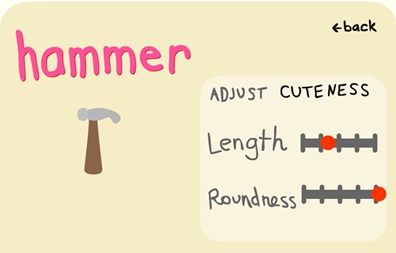
Even inanimate objects can be cute when given disproportionalities that conform to baby schemata, as demonstrated by an interactive tool from the San Francisco Exploratorium’s website (fig. 1).19 The formation of care relationships naturally privilege cuteness, but because there is more in our emotional range than just responding to cuteness, there are more subtle ways we might be enticed into a care relationship, as demonstrated by an unusual but interesting example:
In the 2007 video game Portal, often cited as one of the greatest games of all time by gamers and critics, the player is subjected to a series of increasingly dangerous and bizarre tests and puzzles by a malfunctioning A.I. known as GLaDOS in a mysterious facility referred to as the Aperture Science Enrichment Center. In one test, the player is eventually given an object called the weighted companion cube (fig. 2) and told by GLaDOS “this weighted companion cube will accompany you through the test chamber. Please take care of it.”20 Over the next 5-10 minutes of gameplay, the player forms a care relationship with the weighted companion cube. The cube is useful, like certain other heavy cubes in the game, for opening doors and climbing walls, but the player is always required by the gameplay to carry the cube forward through the test with her. “Please take care of it” is an invitation to form a care relationship and through the care that occurs in the gameplay, the player usually complies.
When the player reaches the end of this test, she is given a disturbing message by GLaDOS: “The weighted companion cube certainly brought you good luck. However, it cannot accompany you for the rest of the test and unfortunately must be euthanized. Please escort your companion cube to the Aperture Science emergency intelligence incinerator.” The player cannot proceed and is trapped until they agree to “euthanize” the metal cube by tossing it in a garbage incinerator.

The GLaDOS A.I. continues to toy with the player’s emotions as she hesitates to destroy the object with which she just formed an emotional care relationship: “Although the euthanizing process is remarkably painful, 8 out of 10 Aperture Science engineers believe that the companion cube is most likely incapable of feeling much pain.” And when the player finally does give in and destroys the cube to escape the chamber, GLaDOS rubs salt in the player’s wound, saying “you euthanized your faithful companion cube more quickly than any test subject on record. Congratulations!” no matter how long the player spends hesitating or searching for a loophole.
Though the scientific viewpoint easily tells us a metal box is just a metal box, that it clearly can’t feel pain (despite what GLaDOS would have us believe), we tend to resist being dissuaded from emotional care relationships by distinctions drawn by reason. This appears to be a case where allowing reason to override sympathy would get us closer to ethical truth, against the cautions of care ethics. Many of us who have played Portal are saddened by our betrayals of a care relationship to a fictional inanimate object. But we also realize that we have been fooled and have a dark sense of humor about it, creating a cognitive dissonance between humor and sadness. Anyone who has spent time around the nerdier college campuses in the late 2000s to early 2010s has seen replicas of the weighted companion cube as keychains, fuzzy dice for car mirrors, stickers, or even pendants: artifacts of gamers’ emotional response to this fictional inanimate object in a brief scene from an old game.
They may not be capable of eliminating this strange emotional relationship, but scientific and reason-based arguments that tell us a metal box is just a metal box and that it lacks the intellectual capacity to feel pain can help us deal with this problem. In care ethics, however, “what makes our fellow beings entitled to basic consideration is surely not intellectual capacity but emotional fellowship.”21
Tom Regan, a reason/rights-based ethicist in support of animal rights, argues that “ethic-of-care feminism… abjures the use of reason” in his 1991 critique. Donovan responds by drawing on “sympathy theorists,” who argue that “experiencing sympathy is a complex intellectual as well as emotional exercise” which requires one to imaginatively construct the other’s situation accurately and thereby to understand it intellectually as well as emotionally.”22
This is her more refined form of care ethics theory, which she calls the “dialogical” mode. The basic premises of this form are (1) that “out of a woman’s relational culture of caring and attentive love… emerges the basis for a feminist ethic for the treatment of animals. We should not kill, eat, torture, and exploit animals because they do not want to be so treated, and we know that” and (2) that we “know that” via “dialogical mode of ethical reasoning, not unlike the dialectical method proposed in standpoint theory, wherein humans pay attention to – listen to – animal communication.23
Donovan argues that a dialogical approach requires us to learn the language of living things that are capable of communicating and that this is part of the duty of care. The inability to understand the dialogue of an owl or jellyfish or tree is a shortcoming on our part. She quotes Alison Jaggar, saying that failures of communication may be avoided or minimized “through improved practices of attentiveness, portraying attentiveness as a kind of discipline whose prerequisites include attitudes and aptitudes such as openness, receptivity, sensitivity, and imagination.”24
But the non-existence of a care relationship with an entity could always be attributed to a failure to recognize or understand the language of that object – even when that object is the weighted companion cube. By exploiting plants by eating them, we could be failing to learn their language as well. Are not fruit trees telling us they don’t want us to eat the fruit by putting it out of our reach? Couldn’t disagreeing with that suggestion always be attributed to an inability or unwillingness to listen to the language of the fruit trees?
Naming empathy, sensitivity, and other emotional traits as the prerequisites to dialogues of care returns the epistemological imperative to emotional knowledge. Donovan calls universal scientific knowledge “pretension.” But how much more of a pretension is the idea we can learn the language of and have a dialogue with a turkey or a fruit tree and be confident in our interpretation of the underlying meaning?
Because imagination is an essential part of communication, the epistemology of dialogical care theory requires an exercise of “moral imagination, an intense attentiveness to another’s reality, which requires strong powers of observation and concentration, as well as faculties of evaluation and judgment. It is a matter of trying to see fairly another’s world, to understand what another’s experience is.”25
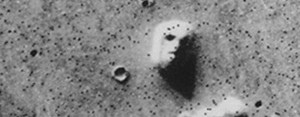
But, like emotion, imagination is easy to fool and manipulate. We see conspiracies or magic in simple coincidences. We see humans in images that barely resemble a human face, like the ‘Face on Mars’ captured by the NASA/JPL Viking 1 Orbiter in 1976.26 In consuming fiction, we naturally imagine ourselves in the place of the protagonist. We imagine ghosts in creaking sounds late at night. Imagination might be the most powerful and profound function of our minds, but it also isn’t selective about what it produces. The merest suggestion can prompt the imagination to produce a kaleidoscope of thoughts, images, and interpretations. How then, can we use imagination as a source of knowledge? Is a better, more educated, and even a more cultivated imagination more inclined to produce truth? Or is it more likely the case that as we learn more about science and the universe we conclude that there probably aren’t ghosts in the house and there’s almost certainly not a human lying in the dust of Mars, even though our imaginations still produce those suggestions?
The A.I. GLaDOS, (and the writers who created her) manipulates our imaginations just like she manipulates our emotions. When she says that “although the euthanizing process is remarkably painful, 8 out of 10 Aperture Science engineers believe that the companion cube is most likely incapable of feeling much pain,” she is prompting our imaginations to think of the possibility that we could be causing a friend who somehow loves us to feel incredible pain. It’s an absurd notion from a scientific perspective, but it’s one the imagination clings to.
Donovan says that duties of care “should be granted to living creatures with whom one can communicate cognitively and emotionally as to their needs and wishes.”27 How do we know that communication is truly cognitive, and not the mechanical communication we have with computers? It doesn’t seem like it’s something we can know emotionally – that’s why Donovan separates communicating cognitively from communicating emotionally. The caveat that such communication must be cognitive sets us back to the same argument that has undergirded reason-based philosophical debate on the subject for millennia: whether animal response is cognitive or mechanical.
In the age of computers, humans are increasingly communicating with entities that appear cognitive but are, in fact, mechanical, and the line will only become more unclear as technology processes. When the player of Portal finally encounters GLaDOS, the A.I. computer which has been running the tests and attempting to kill her, GLaDOS clumsily attempts to emotionally manipulate the player even while trying to poison her with a deadly neurotoxin: “despite your violent behavior, the only thing you’ve managed to break so far is my heart.”28
As the player attempts to destroy the computer, GLaDOS increasingly tries to elicit sympathy, even criticizing the player for her lack of caring: “The difference between us is that I can feel pain. You don’t even care, do you? Did you hear me? I said you don’t care! Are you listening?” GLaDOS screams in apparent pain as the player fights back and eventually manages to destroy the computer’s cores. Mirroring Donovan’s earlier language, GLaDOS doesn’t want to be destroyed, and we know that. At least, we know that in emotional, dialogical, imaginative ways, even if our scientific ways of knowing know that GLaDOS is a computer, and a dangerous one at that.
GLaDOS is a fictional, exaggerated version of the kind of emotional manipulation humans use on each other on a regular basis. Women and men in abusive relationships often still feel a strong emotional relationship with their abuser, and rational arguments have very little power to break those ties. The world isn’t just filled with fictional dialogue that we can interpret as real, it’s filled with outright lies.
Imagination and caring are the most beautiful and profound capacities the human mind has to offer. They make life worth living and knowledge worth knowing. They generate the ideas that reason is tasked with filtering and parsing into rational understanding. Reason doesn’t have to be privileged over caring and imagination, but there are times when reason must have the authority to say, “that isn’t right.” This may require a rethinking of how we relate reason and emotion – not as competing forces in an epistemic battle but as the two parts of one dialectical process. Reason cannot create, but it can filter and reconfigure what emotion and imagination have created, something emotion and imagination cannot do alone. When we no longer think of them as the enemy or victim of reason, our imagination and our capacity for care can lead us not to absurdity, but to truth.
Written April 2021
Endnotes:
- Josephine Donovan, “Feminism and the Treatment of Animals: From Care to Dialogue,” in The Animal Ethics Reader, ed. Susan J. Armstrong and Richard G. Botzler (New York: Routledge, 2017), 44. ↩︎
- Stephanie Collins, The Core of Care Ethics (Hampshire (UK): Palgrave Macmillan, 2015), 1. ↩︎
- Gilligan, In a Different Voice (1982), 19 ↩︎
- Josephine Donovan, “Attention to Suffering: A Feminist Caring Ethic for the Treatment of Animals,” Journal of Social Philosophy vol. 27 no. 1 (Spring 1996), 92, https://fewd.univie.ac.at/fileadmin/user_upload/inst_ethik_wiss_dialog/Donovan__J._1996_Suffering_animals.pdf. ↩︎
- Ibid., 92. ↩︎
- Josephine Donovan, “Feminism and the Treatment of Animals: From Care to Dialogue,” in The Animal Ethics Reader, ed. Susan J. Armstrong and Richard G. Botzler (New York: Routledge, 2017), 42. ↩︎
- Ibid., 42. ↩︎
- Donovan, Animal Rights and Feminist Theory, 65. ↩︎
- Donovan, Animal Rights and Feminist Theory, 66; quoting in part from Max Horkheimer and Theodor F. Adorno, Dialectic of Enlightenment (1944; reprint, New York: Herder & Herder, 1972), 39, 24, 9. ↩︎
- Donovan, Animal Rights and Feminist Theory, 69. ↩︎
- Ibid., 71. ↩︎
- Stephanie Strom, “Ad Featuring Singer Proves Bonanza for the A.S.P.C.A.,” The New York Times (25 December 2008), retrieved 26 April 2022, https://www.nytimes.com/2008/12/26/us/26charity.html. ↩︎
- Donovan, Animal Rights and Feminist Theory; quoting from Carolyn Merchant, The Death of Nature: Women Ecology, and the Scientific Revolution (San Francisco: Harper & Row, 1980), xviii. ↩︎
- Melanie L. Glocker, et. al., “Baby Schema Modulates the Brain Reward System in Nulliparous Women,” Proceedings of the National Academy of Sciences of the United States of America (PNAS), (2 June 2009), Abstract, retrieved 26 April 2022, https://www.pnas.org/doi/10.1073/pnas.0811620106#tab-contributors. ↩︎
- Glocker, Discussion. ↩︎
- Vicky Lehmann, et. al., “The Human and Animal Baby Schema Effect: Correlates of Individual Differences,” Behavioural Processes 94, (2013), 101, retrieved 26 April 2022, https://www.sciencedirect.com/science/article/pii/S0376635713000028/pdfft?casa_token=2ZdKgZ38gdUAAAAA:cxHjWRAe1DH4hYltc7xP2ZJqFbQKTF1etuW3BuLz4mJYAiei9lhpwqrxHWmfwYv4LC3kwN-7eQ&md5=8d48c74954760177862e062216107563&pid=1-s2.0-S0376635713000028-main.pdf. ↩︎
- Lehmann, 102. ↩︎
- Lehmann, 99. ↩︎
- MIND Project, “Cute-ify” (San Francisco Exploratorium, 2008), accessed 4 April 2022, http://annex.exploratorium.edu/mind/judgment/cuteify/v1/. ↩︎
- Kim Swift (designer), Erik Wolpaw, and Chet Faliszek (writers), Portal (Valve, 2007), Test Chamber 17. ↩︎
- Mary Midgley, “Persons and Non-Persons,” in In Defense of Animals (New York: Blackwell, 1985), ed. Peter Singer, 60; quoted by Donovan, Animal Rights and Feminist Theory, 59. ↩︎
- Josephine Donovan, “Attention to Suffering: A Feminist Caring Ethic for the Treatment of Animals,” Journal of Social Philosophy vol. 27 no. 1 (Spring 1996), 83, https://fewd.univie.ac.at/fileadmin/user_upload/inst_ethik_wiss_dialog/Donovan__J._1996_Suffering_animals.pdf; quotes from Tom Regan, The Thee Generation: Reflections on the Coming Revolution (Philadelphia: Temple University Press, 1991), 142. ↩︎
- Donovan, Animal Rights and Feminist Theory, 76; Donovan, Feminism and the Treatment of Animals, 42. ↩︎
- Donovan, Feminism and the Treatment of Animals, 46; quoting from Alison M. Jaggar, “Caring as a Feminist Practice of Moral Reason,” in Justice and Care: Essential Readings in Feminist Ethics, ed. Virginia Held (Boulder, CO: Westview, 1995), 190. ↩︎
- Donovan, Attention to Suffering, 86. ↩︎
- NASA Science, “Unmasking the Face on Mars,” (24 May 2001), retrieved 26 April 2022, https://science.nasa.gov/science-news/science-at-nasa/2001/ast24may_1. ↩︎
- Donovan, Feminism and the Treatment of Animals, 44. ↩︎
- Kim Swift, et. al., Portal, GLaDOS’ Chamber. ↩︎
 adurbin.com