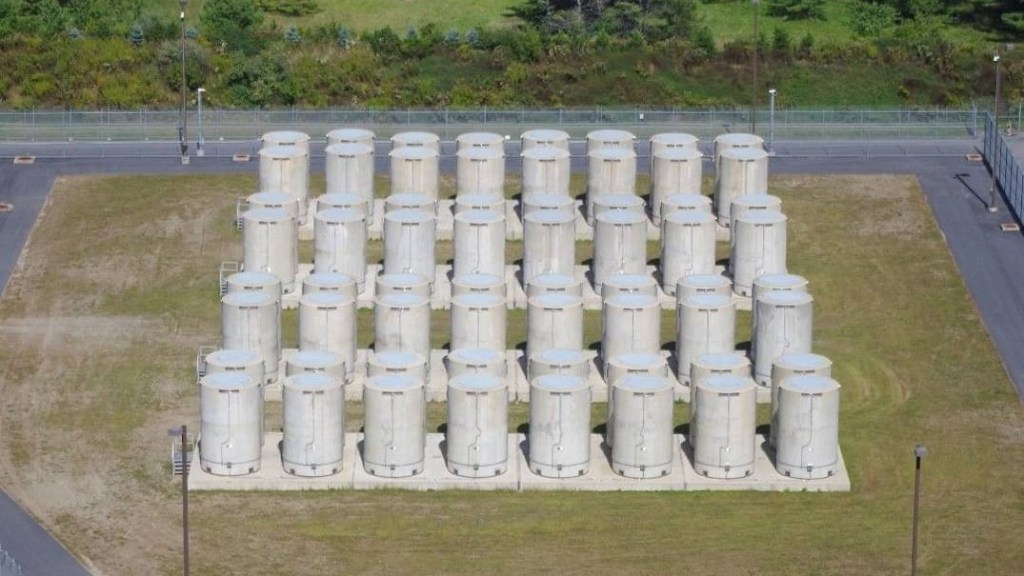
There are 90,000 tons of stored nuclear waste in the United States stored and monitored above ground in secure locations in heavy-duty casks. This is often used as an objection by opponents of nuclear energy because, as the Center for Arms Control and Non-Proliferation bluntly puts, “the federal government has been unable to implement any strategy for its permanent disposal.”1 Meanwhile, the Department of Energy’s one permanent waste storage facility, the Waste Isolation Pilot Plant in New Mexico, is the only modern waste storage facility in the US to suffer an accident leading to radiological release, though even that incident was too small and localized to pose a public health concern, according to the EPA.2
On the surface, it seems that without a solution that allows us to put the waste in a permanent site and then forget about it, nuclear waste is an unsolved problem. International producers of nuclear power such as Germany, France, Sweden, and Finland have been implementing plans for permanent storage of nuclear fuel waste since the 1960s, which involve burying the waste permanently in excavated tunnels at least a thousand feet deep and then sealing them off. This permanent solution was implemented by Germany, which began burying waste 2000 feet underground in 1967 at Asse II, a former salt mine, sealing off the mine in 2004. Just a few years later, brine containing caesium-137 was discovered and attributed to hydrological activity through the sealed mine. The German Federal Ministry for the Environment, Nature Conservation, Nuclear Safety and Consumer Protection is now tasked with the massive project of exhuming the waste for reprocessing and disposal in a new facility.3
In the US, the obstacles that ultimately shut down the 25-year, 12-billion-dollar project to build a permanent disposal site at Yucca Mountain, Nevada were political, rather than technical or environmental.4 Even in the most desolate, remote corners of the country, the local politicians are brought out of the woodwork by high-profile nuclear energy projects. This makes the possibility of a centralized, permanent disposal facility in the United States a political long shot at best. Yet American reactors continue to generate power and continue to store their waste above ground without damage to the environment.
We want a permanent solution, a place where waste can be left forever and forgotten, but we live in a world of constant change, where even the ground we stand on is in flux. A permanent storage solution is predicated on the wishful assumption that our current knowledge regarding the issues related to waste storage is also permanent, that we can know all possible risks with absolute certainty. It asserts that we know enough about radiation, radioactive decay, materials science, geology, hydrology, and even sociology to make a million-year bet.
The impermanence of nuclear waste storage solutions does not, however, mean we have no long-term solution, but it does task those who interact with the issue with the difficult psychological task of accepting change. It’s the same problem we wrestle with when we encounter death and personal change. The culture of our youth, the sites of fond memories in our hometowns, the lifestyles we once lived, our grandparents, parents, friends and family all gradually die out and are replaced. Life goes on despite its impermanence.
The impermanent solution of storing waste above ground is not considered a “long-term” solution for legal and rhetorical purposes. But waste is being stored at de facto long-term storage sites, dubbed “Independent Spent Fuel Storage Installations” by the Nuclear Regulatory Commission, like the Morris Operation in Illinois, which has stored the same collection of spent fuel in the same place since 1989.5 The Department of Energy has taken a similar impermanent but long-term approach to storing some of its legacy wastes. For example, the damaged core and other radioactive wastes from the Three Mile Island incident have been stored above ground at the DoE’s Idaho National Laboratory since they were removed from the plant from 1986-1990.6
Years before, the AEC began burying transuranic waste “permanently” in earth-covered pits in the Idaho desert in the early 1950s until 1970. It was a time where the physics of radioactive decay were understood a lot better than the science of hydrology, and the Department of Energy has been digging up and reprocessing that waste since 1974.7 This ongoing project to reverse a “permanent solution” has taken almost 50 years and continues to cost the DoE over $600 million a year.8 The risks to the aquifer have decreased according to the DoE, but they are also are difficult to quantify when waste is buried out of sight. Above ground, casks can and are regularly inspected for possible signs of aging or defects.9 This means risk can be quantified and mitigated in real time rather than extrapolated tens of thousands of years into the future.
Strictly speaking, above ground storage facilities are less physically secure than a 2000-foot-deep vault, but the extreme minimum safety standards imposed by the Nuclear Regulatory Commission still places dry nuclear waste among the most secure artifacts in the world. Dry storage casks, the standardized way to store cooled waste at nuclear plants and other temporary facilities are built of three-foot-thick walls of steel and concrete and can weigh up to 150 tons.10 Demonstrations have showed casks’ survivability against extreme case incidents like collisions from army missiles and railroad locomotives.11 According to the NRC, “Since the first casks were loaded in 1986, dry storage has released no radiation that affected the public or contaminated the environment.”12
Long-term above ground storage gives us flexibility that permanent solutions preclude, which allows us to adapt as our knowledge increases. Because of the value of knowledge, data, and flexibility the best solution to issues like criticality safety – preventing the spent fuel from resuming its chain reaction – and managing the aging of storage vessels may be keeping the waste above ground where we can keep an eye on it. While it might slightly more vulnerable to the remote threat of theft by terrorists trying to build a radiological weapon than buried waste, because it’s kept in a place where we can watch it and be reasonably assured that it’s still where it’s supposed to be (not to mention the extreme weight of a dry fuel cask, which would require any hypothetical thief to also steal a freight train to move it).
There are methods in the works that may allow spent fuel to be reused and added back into the fuel cycle. In the meantime, we still need to deal with storage of fuel pending that reprocessing. But if and when waste reprocessing becomes widespread, all our efforts to permanently seal off spent fuel will become another egg on our collective face and create another giant expense to exhume it once again. By default, above ground storage casks like those at the Three Mile Island storage facility at Idaho National Laboratory are “designed to allow ready retrieval of spent fuel for further processing or disposal”13
While sealing off waste in a facility like Yucca Mountain is a safer permanent bet than burying it in a shallow grave above a major aquifer, we still shouldn’t be in a hurry to lock in our answer. The so-called “half-life of knowledge” is a small fraction of the half-life of technetium-99. What humanity didn’t know about hydrology, corrosion, and quality control only took 50 years to come back to bite us for our attempts to implement permanent solutions in the desert of Idaho or Asse II in Germany.
This means that our ultimate task in dealing with nuclear waste is learning to accept long-term impermanence. The biggest problem in waste management is psychological, not technical or political. It’s learning to accept that we don’t have all the answers and living with things in an unsettled state for now. It’s learning to live a settled life in an unsettled world.
Written March 2022
Endnotes:
- Luisa Kenausis, “Nuclear Waste Issues in the United States,” (Center for Arms Control and Non-Proliferation Nukes of Hazard Blog, 22 August 2018), retrieved 28 March 2022, https://armscontrolcenter.org/nuclear-waste-issues-in-the-united-states/. ↩︎
- United States Environmental Protection Agency, “EPA Response to 2014 Radioactive Release at the Waste Isolation Pilot Plant (WIPP),” (United States Environmental Protection Agency, 2015), retrieved 28 March 2022, https://www.epa.gov/radiation/2014-radiological-event-wipp#response. ↩︎
- World Nuclear News, “Contract awarded for planning of Asse II facilities,” (World Nuclear News, 11 January 2022), retrieved 28 March 2022, https://www.world-nuclear-news.org/Articles/Contract-awarded-for-planning-of-Asse-II-facilitie. ↩︎
- Hannah Northey, “GAO: Death of Yucca Mountain Caused by Political Maneuvering,” (The New York Times, 10 May 2011), https://archive.nytimes.com/www.nytimes.com/gwire/2011/05/10/10greenwire-gao-death-of-yucca-mountain-caused-by-politica-36298.html?pagewanted=all. ↩︎
- United States Nuclear Regulatory Commission, “GE Nuclear Energy, Morris Operation – Technical Specifications for Safety Amendment 12,” (United Sates Nuclear Regulatory Commission), 6, Retrieved 26 March 2022, https://www.nrc.gov/docs/ML0431/ML043140343.pdf. ↩︎
- Idaho Cleanup Project, “Three-Mile Island Unit 2 Independent Spent Fuel Storage Installation License Renewal – Project Execution Plan” (United States Department of Energy, 3 May 2011), 5, retrieved 26 March 2022, https://www.id.energy.gov/doeid/STIContract/SEC%20C/SEC%20C%20Exhibits/C-29/C-29,%20PLN-3660;%20TMI-2%20ISFSI%20License%20Renewal.pdf. ↩︎
- United States Department of Energy, Idaho Cleanup Project Citizens Advisory Board, “A Brief History of RWMC,” (United States Department of Energy, 14 June 2017), retrieved 26 March 2022, https://www.energy.gov/em/icpcab/articles/brief-history-rwmc. ↩︎
- United States Department of Energy, Office of Environmental Management, “DOE Awards Idaho Cleanup Project Contract,” (Department of Energy, 27 May 2021), retrieved 26 March 2022, https://www.energy.gov/em/articles/doe-awards-idaho-cleanup-project-contract. ↩︎
- Idaho Cleanup Project, 13-15. ↩︎
- United States Nuclear Regulatory Commission, “Safety of Spent Fuel Storage,” (U.S. Nuclear Regulatory Commission, April 2017), retrieved 27 March 2022, https://www.nrc.gov/docs/ML1710/ML17108A306.pdf. ↩︎
- Holtec International, “Aircraft Impact Test of a Fuel Storage Cask,” (HoltecInternational.com, 2013), retrieved 26 March 2022, https://holtecinternational.com/news/videos/aircraft-crash-test-on-a-scaled-model-of-a-hi-star-180-transportstorage-cask-2/; Central Electricity Generating Board (UK), “Operation Smash Hit,” (1984), retrieved 26 March 2022, https://www.youtube.com/watch?v=hTshPr2TogE. ↩︎
- United States Nuclear Regulatory Commission, 2. ↩︎
- Idaho Cleanup Project, 14. ↩︎
 adurbin.com